What Cooling U.S. Jobs Data Really Means for Crypto Investors
A weaker-than-expected June jobs report, with only 57,000 nonfarm payrolls added and prior months revised down by 74,000, has strengthened Fed rate-cut expectations — and with them, the macro case for Bitcoin and crypto assets.
The latest U.S. employment report for June delivered a clear message to financial markets: the labor market is softening, and the Federal Reserve's window for rate cuts is opening wider. For Bitcoin and broader crypto markets, this is not just a headline catalyst — it reflects a structural macro shift that historically drives capital into risk-sensitive assets.
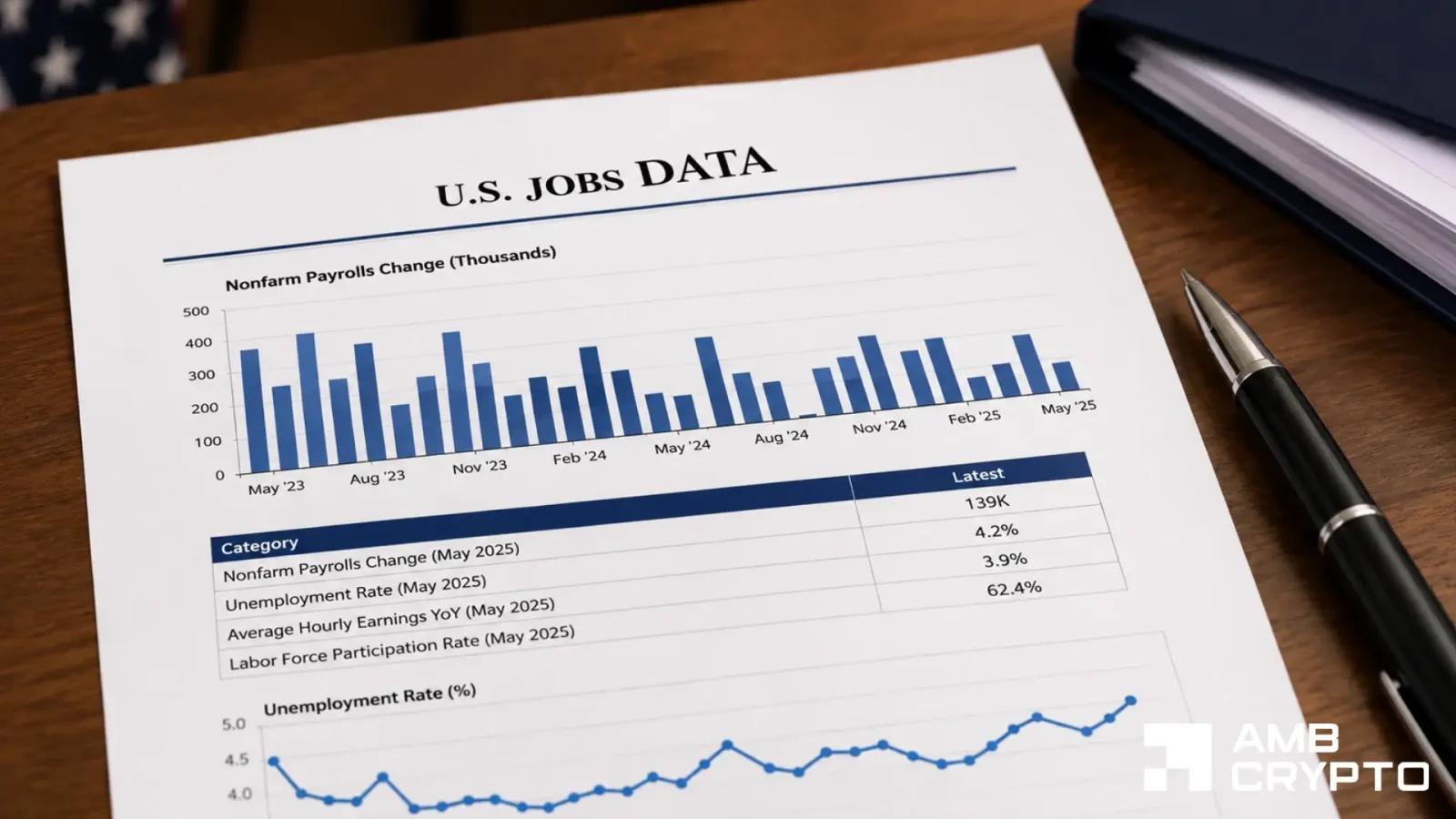
The Bureau of Labor Statistics reported that the U.S. economy added only 57,000 nonfarm payroll jobs in June, a sharp deceleration from a revised 129,000 in May. Critically, April and May figures were revised down by a combined 74,000 jobs, meaning the labor market had been even weaker than markets previously assumed. The unemployment rate edged slightly lower to 4.2% from 4.3%, but this improvement is deceptive — the labor force participation rate simultaneously slipped from 61.8% to 61.5%, suggesting fewer Americans were actively engaged in the workforce rather than genuine job creation accelerating.
Average hourly earnings rose 0.3% month-over-month and 3.5% year-over-year, a pace that signals wage pressures are easing without triggering alarm. Sector-level data adds further nuance: gains were concentrated in professional and business services, healthcare, and social assistance — relatively stable, non-cyclical areas — while leisure and hospitality shed 61,000 jobs due to weaker-than-usual seasonal hiring. This composition tells a story of an economy decelerating in the more economically sensitive segments.
The market reaction was immediate and instructive. U.S. Treasury yields fell across the curve, with the policy-sensitive two-year yield declining alongside the benchmark 10-year. The U.S. Dollar Index also weakened as traders repriced the interest rate outlook. Both Bitcoin and Ether moved higher in response, as investors rotated toward risk assets in anticipation of looser financial conditions ahead.
Why does this matter so profoundly for crypto? Lower interest rates reduce the opportunity cost of holding non-yielding assets like Bitcoin. A weaker dollar historically correlates with stronger performance in dollar-denominated commodities and digital assets. Combined with declining Treasury yields, these conditions have been a reliable tailwind for crypto during previous Fed easing cycles. The current setup is beginning to replicate that pattern.
However, the June jobs report alone will not force the Fed's hand. Policymakers have repeatedly emphasized that they need sustained evidence of disinflation before acting. The next pivotal data points are the Consumer Price Index and Personal Consumption Expenditures releases — if these continue to moderate, the case for a rate cut later in 2025 becomes increasingly difficult to dismiss.
For crypto investors, the strategic takeaway is this: the macro environment is gradually rotating in favor of digital assets. Softer hiring, downward payroll revisions, a retreating dollar, and falling yields form the precise cocktail that has preceded major crypto rallies in past easing cycles. This does not guarantee price appreciation, but it meaningfully improves the risk-reward backdrop. Investors positioning ahead of confirmed Fed easing — rather than reacting after the fact — stand to benefit most from this evolving macro setup.