Polygon Destroys Over 107M POL Tokens in 2026 — Yet the Price Keeps Falling
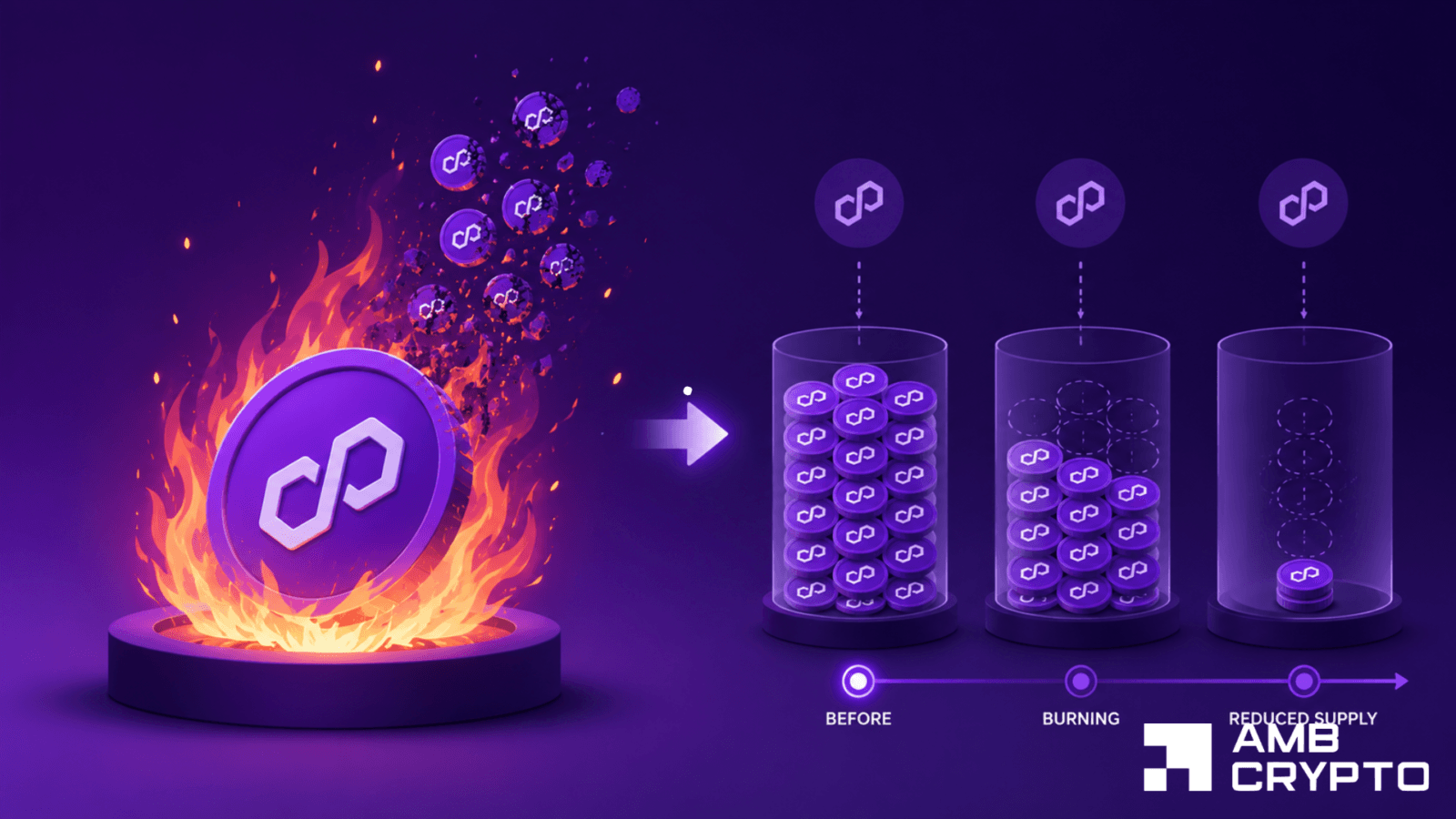
Polygon has burned over 107 million POL tokens in 2026 and achieved net deflation, yet the token's price continues to decline amid persistent technical selling pressure.
Polygon (POL) has established itself as one of the most actively used blockchain networks for payments, with transaction volumes rivaling and at times exceeding those of well-known platforms such as Solana (SOL). However, despite impressive on-chain fundamentals, the token's market price continues to slide.
Over the past 24 hours, POL has dropped more than 1%, breaking below the key support level at $0.07161. At the time of writing, the altcoin is changing hands at approximately $0.06948. The price weakness stands in sharp contrast to the network's growing activity and improving underlying metrics.
**Massive Token Burns and Net Deflation**
Sandeep Nailwal, co-founder and CEO of Polygon, recently announced on X that the network has burned over 107 million POL tokens in 2026 alone, officially declaring Polygon net deflationary for the year. This is a remarkable milestone, especially considering that during the same period, the protocol minted more than 105 million POL tokens.
The burned tokens originated from base fees collected on the network. The result is a slight but meaningful reduction in the circulating supply — a dynamic that typically supports price appreciation in the long run.
By comparison, major competitors including Ethereum (ETH), Solana, and Sui Network (SUI) have added hundreds of millions of dollars worth of newly minted tokens to the market, expanding rather than contracting their respective supplies.
**Payment Volume and Stablecoin Activity**
The elevated burn rate is a direct consequence of surging transaction activity on the Polygon network, which has been gaining traction as a leading payment infrastructure. In May, Polygon recorded the highest stablecoin volume among all payment networks, reaching an impressive 198 million transactions. This positions the network as a dominant force in the on-chain payments space.
**Whales and Staking Signal Confidence**
Large holders are also showing signs of continued confidence in the project. One notable whale recently migrated 17.512 million MATIC tokens into their POL equivalent — a position worth approximately $1.25 million. This conversion suggests that significant investors remain committed to the Polygon ecosystem.
Additionally, a multisig wallet associated with Stader Labs and Polygon staked 11 million POL tokens, valued at around $839,410. In total, this wallet has now staked over 28 million POL tokens. Such staking activity reduces the available circulating supply and simultaneously strengthens network security — both positive indicators for long-term value.
**So Why Is the Price Falling?**
Despite all the positive fundamentals, POL's price action tells a different story. Since late 2024, the token has been in a sustained downtrend. On the weekly chart, the altcoin appears to be trading within a converging triangle pattern, suggesting a breakout — in either direction — may be imminent.
Technical indicators paint a bearish picture. The Bull Bear Power indicator has remained in the red since October 2025, reflecting strong seller dominance. The Cumulative Volume Delta (CVD) further confirms this trend, with data showing approximately 670,000 POL tokens offloaded onto exchanges in recent sessions.
In essence, the gap between Polygon's improving fundamentals and its deteriorating price action can be attributed to persistent technical selling pressure. Despite growing burn rates and rising transaction counts, bearish momentum in the market continues to outweigh the positive on-chain signals.
**Key Takeaways**
Polygon has burned over 107 million POL tokens in 2026, becoming net deflationary for the year. Its stablecoin transaction volume hit 198 million in May — the highest among all payment networks. Whale activity and staking further support the ecosystem's health. Nevertheless, POL remains trapped in a descending triangle pattern and under significant selling pressure, keeping prices suppressed despite strong network performance.